
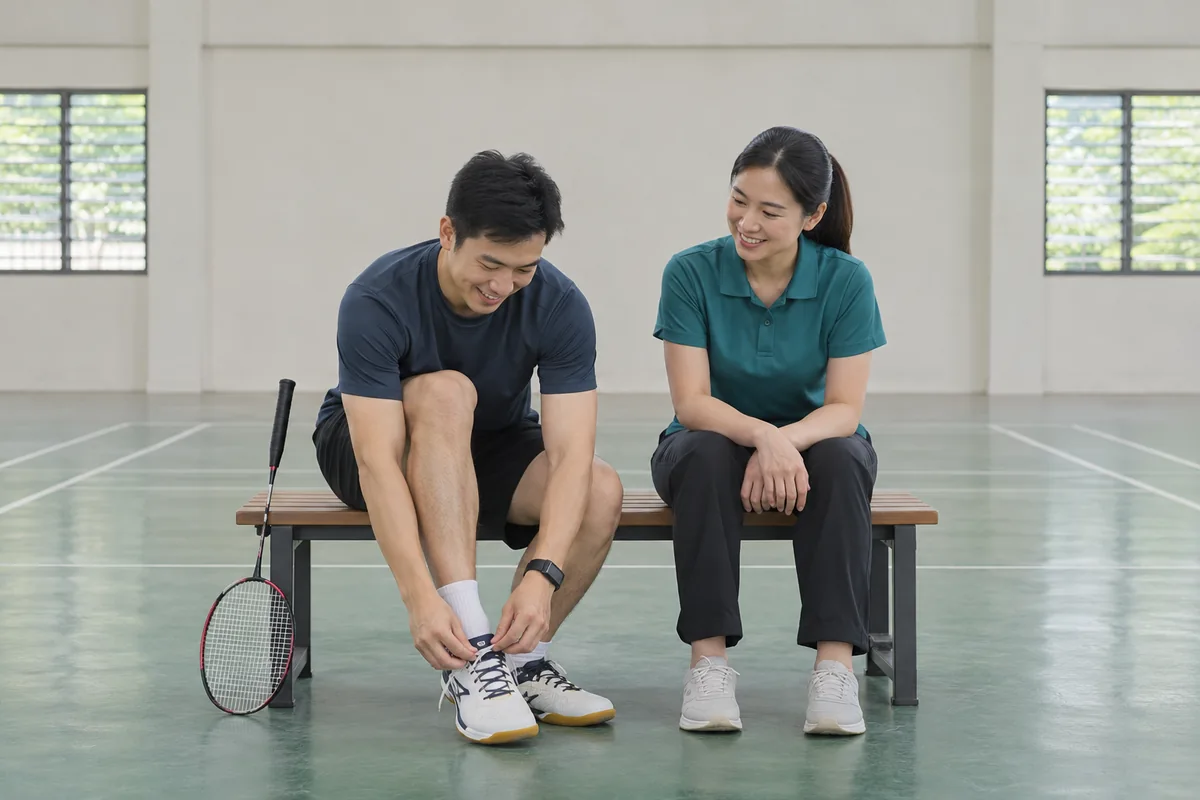
What is sports injury rehabilitation?
Sports injury rehabilitation treats the injury and then prepares you to play again safely. It covers sprains, strains, tendon pain, joint injuries and recovery after sports surgery.
The aim is not just to be pain-free for daily life. It is to move, jump, twist or run at the level your sport asks for, with the confidence to do it without holding back.
Who is it for?
It is for anyone who plays, from a weekday badminton group to a futsal team, a cyclist, a hiker or a gym-goer. You do not need to be an athlete. If an injury has stopped you from doing something you enjoy, this is for you.
It is also for people whose injury is old. A shoulder that clicks every time you smash, or a knee that swells after Bukit Kledang, may have a cause that rest never fixed.
Which sports injuries do you see in Ipoh?
The pattern follows how Ipoh plays. Badminton halls bring shoulder, knee and Achilles injuries. Futsal and football bring ankle sprains and hamstring strains.
The hills bring their own problems. Hiking Bukit Kledang or running its trails can leave knees sore on the way down, and wet rocks cause ankle rolls. Cycling and running in the heat add overuse issues in the knees, hips and feet.
Our pages cover these, including ankle sprain, anterior cruciate ligament (ACL) injury and hiking and knee pain.
What is the first visit like?
We ask how it happened and what you want to get back to. We then check swelling, movement, strength and balance, and test the movements that hurt.
You leave knowing what we think is going on, what to avoid for now and a plan you can start that day. If the injury needs a scan or a specialist, we tell you.
How does exercise lead the plan?
Exercise is the core of nearly every sports rehab plan. The Aspetar clinical practice guideline on rehabilitation after anterior cruciate ligament (ACL) reconstruction identifies exercise as the main component, but finds little evidence on dose [1].
It also says certainty is very low for most components, with a number of recommendations based on expert agreement [1]. We say this plainly: good rehabilitation is careful judgement, not a formula.
For ankle sprains, the Journal of Orthopaedic & Sports Physical Therapy (JOSPT) guideline was revised in 2021 and covers first-time sprains and chronic ankle instability [2]. We use guidelines like these as a map, then adjust for the person in front of us.
How do we decide you are ready to play?
The calendar is a poor judge. A date such as “six weeks” says little about whether the joint can take a landing or a sudden stop.
Before you return, we look for these signs:
- The injured side matches the other side in strength and control.
- You can hop, land, change direction and jump without pain or fear.
- Swelling stays down after a hard session.
- You have rebuilt your general fitness, so you do not tire and tighten up.
- You feel ready, because fear of re-injury can slow you more than the joint.
Return to the sport in steps, for example drills, then a short game, then a full match.
Can I stay fit while injured?
Yes, and it helps the return. If your leg is hurt, you can train the upper body and core. If your shoulder is hurt, you can still walk, cycle gently or work your legs.
We plan what you can safely do, so you keep your fitness and your mood. It is much easier to come back from “slightly out of shape” than from “nothing for three months”.
When should you see a doctor first?
Seek urgent medical care if you cannot bear weight after a fall or a joint looks out of shape. Go too if swelling is severe, if there is numbness, or if you hit your head and feel confused.
Otherwise, a physiotherapist is a good first stop for most strains and sprains. We refer you on when needed.
Home visit or our centre?
For early recovery, a home visit is the practical choice. We can start the moment you feel ready, without making you drive with a sore knee.
Our Canning Garden centre is opening soon, and will suit later-stage training that needs equipment. Read about exercise rehabilitation or home physiotherapy, and ask for a quote on WhatsApp.